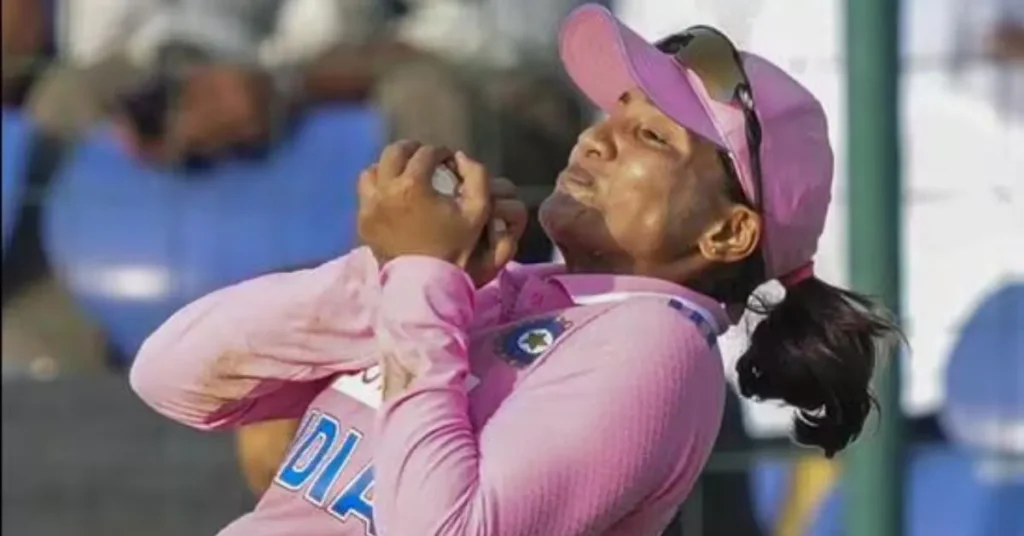
As the India women’s cricket team gears up for the ODI World Cup beginning Tuesday, optimism around their batting depth and bowling options is being overshadowed by one glaring weakness — fielding and catching inconsistency.

During the recent home ODI series against Australia, which India lost 1-2, captain Harmanpreet Kaur openly admitted that missed chances cost the team dearly. Vice-captain Smriti Mandhana also emphasized that fielding standards need urgent improvement before India begin their campaign against Sri Lanka in Guwahati.
“Australia is always a great opposition to test ourselves,” Mandhana said after the series. “We’ve seen the difference between the two sides in fielding. As a team, we need to be more consistent — not just rely on individual brilliance but field together as a unit.”
Numbers Paint a Grim Picture
According to CricViz data, India have dropped 38 catches in their last five ODI series, including 12 against Australia alone. Their catching efficiency in the series was just 57% — 16 catches taken and 12 dropped. Against world-class opponents like Australia, such inefficiency can be the difference between victory and defeat.
For instance:
Phoebe Litchfield was dropped twice in the first ODI in New Chandigarh, going on to score a match-winning 88.
In the third ODI, Georgia Voll was dropped three times and went on to score 81, laying the foundation for Australia’s 412, their joint-highest total.
Inconsistent Standards Across Series
India’s fielding performances have fluctuated wildly:
86% efficiency vs West Indies (December 2024)
53% vs Ireland (January 2025)
66% in the Tri-series vs Sri Lanka and South Africa (May 2025)
67% in the away series vs England
Since January 2024, India’s overall ODI catching efficiency is 66% (119 catches taken, 60 dropped) — among the lowest for top-tier teams. In comparison:
New Zealand: 79%
South Africa: 77%
Australia: 76%
England: 72%
Sri Lanka: 69%
Bangladesh: 64%
Pakistan: 63%
This gap highlights how far India lag behind the global elite in this critical department.
Individual Performers: Mixed Results
Jemimah Rodrigues has been India’s most consistent fielder, with 10 catches and a solid 77% efficiency.
Harmanpreet Kaur (73%) and Arundhati Reddy (70%) have also been reliable.
Radha Yadav, despite limited opportunities, is regarded as one of the best natural fielders in the squad.
On the other hand, wicketkeeper Richa Ghosh has struggled, with just 53% efficiency — 8 catches taken but 7 drops. For a keeper, where every chance matters, this inconsistency puts additional pressure on bowlers.
A Crucial Weakness Before the World Cup
Fielding is not just about saving runs but also about converting half-chances into breakthroughs — something that defines champions in global tournaments. While India’s batting and bowling units are capable of competing with the best, the fielding gap remains a major hurdle.
Opposition teams will likely target this vulnerability, knowing that in crunch moments, dropped catches could cost India dearly. For a side still chasing their first-ever Women’s ODI World Cup title, this weakness could prove decisive.
India will need to raise their standards on the field if they are to turn potential into silverware — because in the World Cup, one dropped chance could well mean dropping the Cup itself.
Also Read: Mithun Manhas Elected as New BCCI President, Amita Sharma to Lead Women’s Selection Panel

Hi, I’m Punith, the founder of IPLMatchUpdates.in. I’ve been following and analyzing IPL and international cricket for over a decade, and my goal is to bring fans accurate news, live updates, and detailed match insights straight from the world of cricket.
Cricket isn’t just a sport to me — it’s a passion. When I’m not writing or sharing updates, you’ll find me analyzing match strategies, reviewing player performances, or debating cricket stats with fellow fans.
Through IPLMatchUpdates.in, I aim to make every cricket lover feel closer to the game we all love.